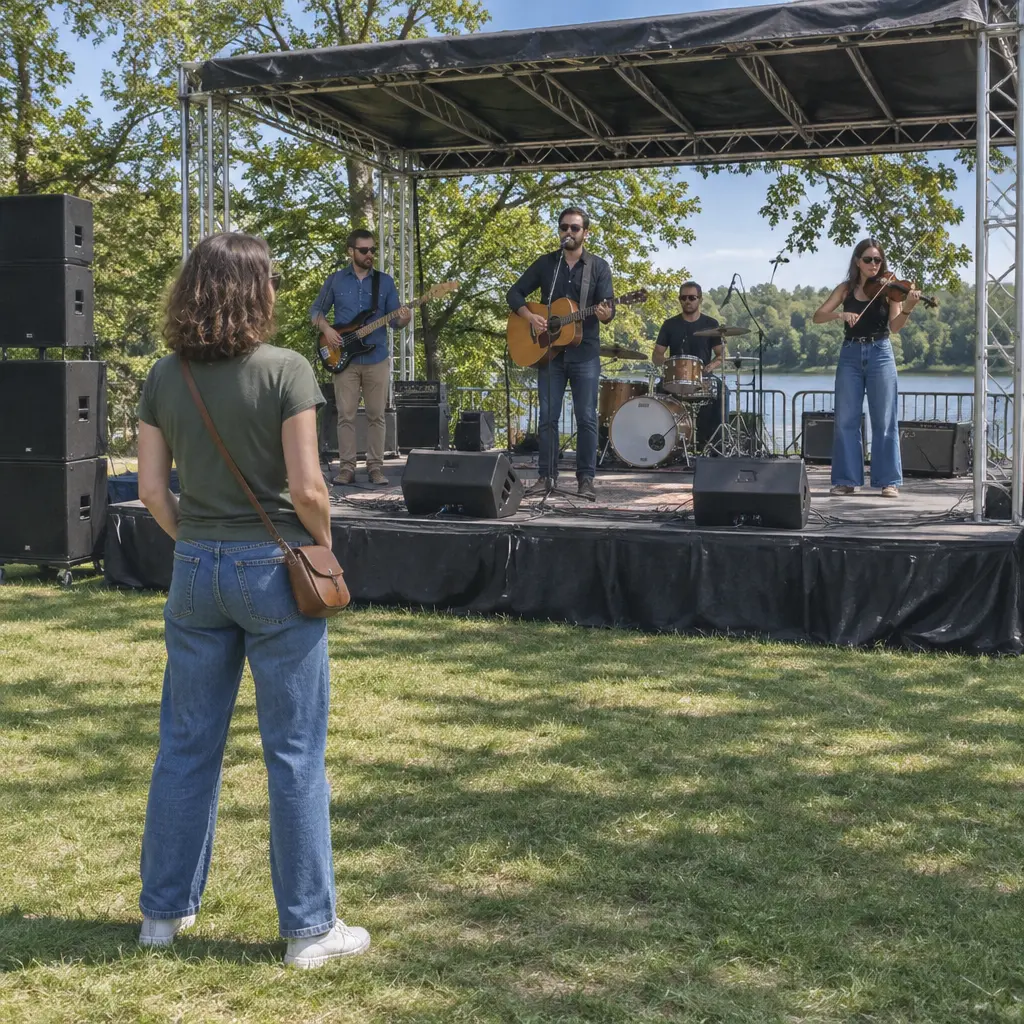
Live music value is the worth audiences derive from a performance in the room: its musical quality, emotional impact, social experience, and cost. Acoustic authenticity means the audible result remains meaningfully connected to performers’ live voices and instruments, even when microphones and sound reinforcement are used. Production spectacle—large-scale staging, video, lighting, effects, and synchronized technology—can add excitement, but it is not a reliable substitute for musical presence. The strongest way to assess a concert is therefore not to treat authenticity and spectacle as opposites, but to ask whether production serves the performance. That distinction matters in a global recorded-music market that generated US$29.6 billion in 2024, according to the International Federation of the Phonographic Industry: recorded music and live performance are different products, and live music’s distinctive value lies in what happens in shared time and space.
Live Music Value and Acoustic Authenticity
Live music value is a multidimensional judgment rather than a simple measure of ticket price, venue size, or technical complexity. There is no single industry-wide metric that calculates how much of a concert’s value comes from authentic performance versus production. A useful assessment instead considers audible evidence, artist-audience connection, the role of technology, and the overall experience in relation to cost.
Research on live music helps explain why this experience cannot be reduced to sound quality alone. A 2014 study by music psychologist Patrick F. E. Vuoskoski and colleagues, published in PLoS ONE, found differences in listeners’ emotional responses to live and recorded music under the conditions examined. The finding does not prove that every live show is superior; it supports the narrower point that performance context can contribute to musical experience. For audiences, the practical question is whether the event’s sound, performance, and staging combine to create a compelling experience.
What acoustic authenticity means
Acoustic authenticity is the perceived credibility of the musical event: listeners can hear performers making consequential musical choices in real time, and the sound remains recognizably linked to those choices. It does not mean that every instrument must be unamplified or that a concert must reproduce a studio recording note for note. In a large venue, microphones, speakers, equalization, and monitoring can make a live performance audible without making it less authentic.
The term is best understood as a spectrum rather than a binary. An intimate acoustic set, a jazz performance with improvised passages, a full-band concert with amplified vocals, and an electronically produced show can all be authentic if the audible result reflects what performers are actually doing. Conversely, a visually elaborate show can feel musically disconnected if prominent prerecorded material obscures the live contribution or if staging leaves little room for interpretation.
What production spectacle contributes
Production spectacle refers to the coordinated visual and technical elements surrounding a performance, including lighting, scenic design, video screens, pyrotechnics, choreography, and automated effects. These elements can improve visibility in a large venue, create dramatic transitions, and give a concert a distinctive visual identity. Their value depends on execution: a screen that lets distant listeners see a performer’s expression serves the event differently from an effect that distracts from the music.
The contrast is not “real music” versus “technology.” Live sound reinforcement is itself a technology, and contemporary concerts may rely on digital mixing, instrument processing, and synchronized cues. The more useful distinction is between production that supports musical communication and production that competes with or conceals it.
Acoustic Authenticity, Performance Evidence, and Musical Presence
Acoustic authenticity becomes easier to assess when translated into observable qualities. These include audible live playing or singing, responsiveness to the room, musical variation, and a credible relationship between what the audience sees and what it hears. None alone is conclusive: a polished performance may be entirely live, while an improvised moment does not automatically make a concert satisfying. Together, however, they help distinguish active performance from a primarily fixed presentation.
Live contribution and audible evidence
Live contribution means that the performers’ actions materially shape the sound during the concert. Relevant evidence can include live vocals, instrumental parts, harmonies, percussion, or other elements that can be heard as part of the event. Backing tracks and prerecorded components do not by themselves invalidate a performance; the key issue is whether they supplement the musicians or replace the contribution audiences reasonably expect to hear live.
For a fair assessment, listeners should avoid assuming that a particular sound must be prerecorded simply because it is consistent or highly polished. Conversely, a visible instrument does not prove that it is carrying an audible part. The most useful questions are practical: Can the audience hear meaningful live performance? Does the arrangement leave space for it? Is the production transparent enough that the relationship between performer and sound remains credible?
Variation, improvisation, and risk
Variation is a change in interpretation, arrangement, tempo, phrasing, or interaction from one performance to another. Improvisation is a more specific form of variation in which performers create or adapt musical material in the moment. These qualities can make a show feel immediate because the outcome is not entirely predetermined, but authenticity does not require every artist or genre to improvise.
A songwriter may deliver a carefully rehearsed arrangement with conviction; a classical ensemble may adhere closely to a score while still making interpretive choices; and an electronic artist may shape a live set through real-time control of sound. In each case, the relevant measure is whether the concert presents a genuine performance rather than whether it conforms to one genre’s expectations of spontaneity.
Room acoustics and sound reinforcement
Room acoustics describe how sound behaves in a space, including reflections, reverberation, and clarity. Sound reinforcement uses microphones, processing, and loudspeakers to distribute or shape sound for the audience. A well-reinforced concert can preserve musical detail and balance; a poorly managed system can make vocals difficult to understand or instruments feel harsh, reducing value even when the performers are excellent.
The National Institute for Occupational Safety and Health identifies 85 decibels, measured as an eight-hour time-weighted average, as a recommended exposure limit for workplace noise. That occupational benchmark is not a universal safe-volume rating for every concert, because exposure depends on both sound level and duration. Still, it underscores that loudness is not the same as quality. Audiences can consider clarity, comfort, and hearing protection alongside volume when judging a live event.
Production Spectacle, Technology, and Audience Experience
Once musical presence is considered, production can be assessed by what it adds to the experience. Spectacle may expand a concert’s visual scale, clarify the performance for distant seats, or support a narrative that would be difficult to convey through sound alone. It becomes less effective when the visual program is repetitive, poorly synchronized, or so dominant that it distracts from the music.
Stage design, lighting, and video
Stage design is the arrangement of performers, scenic elements, and equipment; lighting and video extend that design through visual cues and projected imagery. These tools can make a concert legible across a large venue, direct attention to different performers, and create a sense of occasion. Their contribution is strongest when visual changes correspond to musical structure or help the audience follow the performance.
A useful audience test is to consider whether a production element improves access, meaning, or atmosphere. Large screens may help people far from the stage see facial expressions. A lighting shift can mark a quiet passage or intensify a climax. If effects repeat without musical purpose, however, their technical scale may not translate into greater perceived value.
Playback, synchronization, and electronic performance
Playback is the use of prerecorded audio during a live event; synchronization coordinates sound, lighting, video, or movement through shared timing systems. Both are established production tools. Playback may support complex arrangements, reinforce a sound that cannot be recreated fully onstage, or provide transitions, while synchronization can make intricate cues reliable.
Their presence is not a sufficient basis for judging quality or honesty. A better assessment asks what is performed live, how the recorded material functions, and whether the concert’s presentation sets accurate audience expectations. Electronic music offers a clear example: a performer may use sequenced material while actively manipulating synthesizers, samples, and controls. In that setting, live authorship can be expressed through real-time decisions even when some components are prearranged.
Scale, intimacy, and performer-audience connection
Scale describes the physical and technical size of an event, while intimacy refers to the audience’s perceived closeness to the performers. A small venue can encourage conversation, eye contact, and audible detail, but it may also have weak acoustics or limited sightlines. A stadium can feel distant, yet thoughtful staging, clear sound, and direct audience engagement can create a strong sense of connection.
Audience experience is therefore shaped by more than capacity. In its 2024 publication on music’s economic contribution, the Recording Industry Association of America reported that the U.S. recorded-music industry generated US$17.7 billion in retail revenue in 2023. That figure describes recorded music, not concert earnings, and should not be used as a measure of live-show value. It does provide useful context: concerts compete within a broader music economy where listeners can access recordings on demand, making the distinctiveness of a shared live event especially important.
Assessing Live Music Value in Practice
A practical assessment combines musical, technical, experiential, and financial questions rather than relying on one visible feature. The following framework is not an industry standard or a statistically validated scoring model; it is a transparent way for audiences, critics, and venue operators to explain what they value and why.
A balanced concert-value checklist
- Musical presence: Are live vocals, instruments, or real-time electronic decisions audible and consequential?
- Performance quality: Are musicianship, interpretation, timing, and ensemble interaction convincing?
- Sound: Can listeners hear the music clearly at a comfortable level from their location?
- Production purpose: Do lighting, video, staging, and effects support the music or audience access?
- Connection: Does the performance create a sense of shared attention between performers and audience?
- Value for cost: Does the complete experience justify the ticket price, travel, time, and any additional charges?
The checklist also makes comparisons fairer across genres. A stripped-down acoustic set should not be penalized for lacking pyrotechnics, and a highly produced pop show should not be dismissed simply because it uses technology. The appropriate standard is whether the event delivers on its artistic aims and whether its production strengthens, rather than substitutes for, its musical and human value.
Case example: small-room performance and arena production
Consider two hypothetical shows. A singer-songwriter in a small room performs with voice and guitar, adjusts the set in response to the audience, and is heard clearly from most seats. The event may offer high acoustic intimacy and visible musical authorship, even with minimal staging. An arena artist may use a large video wall, choreographed lighting, and synchronized effects while also delivering live vocals and instrumental passages. That production may provide strong spectacle and broad visibility without sacrificing authenticity.
Neither example is automatically better. If the small room has poor sound or the performance feels disengaged, its intimacy may not deliver value. If the arena’s effects overwhelm the music or the audience cannot hear the live contribution, its scale may not compensate. The comparison shows why the core assessment concerns alignment: what the artist intends, what the production communicates, and what the audience actually experiences.
A simple visual comparison
A useful chart would place acoustic authenticity on the horizontal axis and production spectacle on the vertical axis. A concert with high authenticity and modest spectacle would sit toward the right and lower area; one with high values for both would appear in the upper-right area. The chart should not label either region as universally superior: its purpose is to show that spectacle and authenticity are separate dimensions, and that a concert can be strong in either or both.
Conclusion: Value the Performance, Not Just Its Scale
Live music value is best judged through the relationship between acoustic authenticity, musical presence, production choices, audience connection, and cost. Authenticity does not require an unamplified stage or the absence of playback; it requires a credible connection between performers’ actions and the musical experience. Spectacle can increase access, drama, and visual impact, but technical scale alone does not establish artistic or audience value.
For listeners, the practical next step is to assess concerts across both dimensions: notice what is happening musically, consider what the production contributes, and weigh the whole experience against its cost. For artists and venues, clear communication, good sound, and production that serves the performance can strengthen trust and make live events more distinctive. As music consumption continues to include both on-demand recordings and in-person events, protecting the particular value of shared performance remains essential.
Sources: International Federation of the Phonographic Industry, Global Music Report 2025, https://www.ifpi.org/our-industry/global-music-report/; Vuoskoski, Patrick F. E., et al., “The Pleasures of Music: A Study of Emotional Responses to Music in Live and Recorded Performance,” PLoS ONE, 2014, https://doi.org/10.1371/journal.pone.0113545; National Institute for Occupational Safety and Health, Criteria for a Recommended Standard: Occupational Noise Exposure, https://www.cdc.gov/niosh/docs/98-126/; Recording Industry Association of America, 2023 Year-End Revenue Statistics, https://www.riaa.com/reports/2023-year-end-revenue-statistics/.